Two-player beach practice
A worked 45-minute session and space to record the next practice choice.
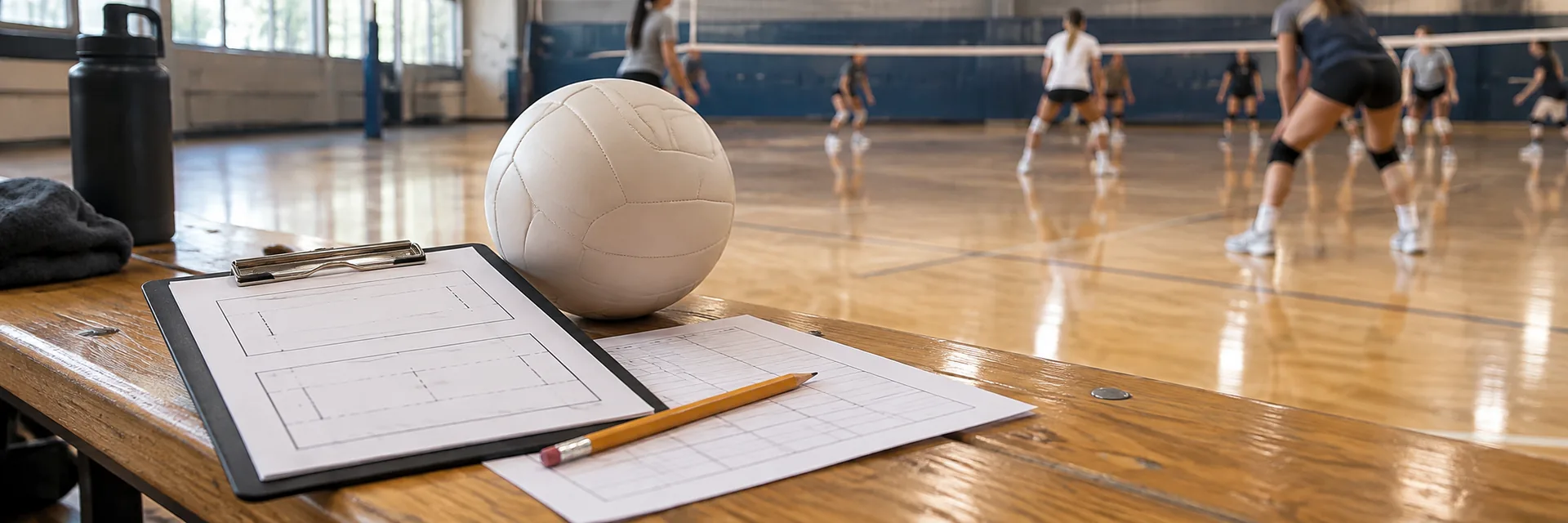
Free print-and-write PDFs for coaches, teachers and players. Blank templates work for any group: a session plan, plain courts, drill diagrams, a rotation worksheet and a simple observation sheet. Worked examples show one 90-minute practice and 5-1 and 6-2 serve receive. Reference and tracking sheets cover match stats, pass ratings, an FIVB rules summary and a court with numbered zones. Each one comes in US Letter and A4. No sign-up needed.
Choose a guide, then download its checklist or card. The PDFs are for printing and writing; the text version can be adapted in your own editor.
A worked 45-minute session and space to record the next practice choice.
A repeatable observation task and blank notes for conditions and adjustments.
An indoor duty checklist, three practice decisions and blank briefing fields.
A customizable agenda, agreement prompts and fictional message examples.
Three schematic examples, a fictional completed card and a blank team agreement.
All PDFs are for printing and writing by hand; they have no fillable fields. Measurements are printed in both metric and imperial, so the site’s unit setting does not change a downloaded PDF. Free to print for personal, school, club and coaching use. The blank templates are also available in español, português, français and 日本語.
A three-page print-and-write pack for a coach or teacher leading 8 beginners: one worked 45-minute session, an adaptable blank plan and an observation sheet. Free in A4 and US Letter; no sign-up.
Worked example: 8 beginners | 45 minutes | 4 balls | 1 coach or teacher
Start with page 1. Check the space and equipment before the group arrives; use pages 2 and 3 to adapt and review your next session.
Download the three-page pack (PDF): US Letter A4
Next: read the full partner-passing drill, then adapt the plan to your group. For a longer teaching sequence, use the PE lessons.
Partner passing · PE lesson plans · More blank session plans
A blank plan for any session length, group or space: columns for time, activity, goal or cue and equipment, plus room for adaptations and notes.
Download (PDF): US Letter · A4
See also: Drill Library
An indoor 6-a-side court with only the boundary, net and attack lines: a full court on page 1 and two half courts on page 2. No zone numbers, so your own drawings stand out.
Download (PDF): US Letter · A4
See also: Court Dimensions
Two plain half courts per page, each with lines for the drill name, setup, steps and coaching cues.
Download (PDF): US Letter · A4
See also: Drill Library
Two pages for any six-player lineup: a service-order table with room for full names, an optional role key, and six plain courts, each with a grid for who holds each rotational position.
Download (PDF): US Letter · A4
See also: Overlap Rules
Choose up to three skills, mark + or – for each player, and note what went well and one thing to work on. A beginner-friendly alternative to the detailed stats sheet.
Download (PDF): US Letter · A4
See also: Scoring & Stats
A worked example of one 90-minute session, from warm-up to game-like play and cool-down. Change the times to suit your group, and take breaks whenever players need them.
Download (PDF): US Letter · A4
See also: Drill Library
One way to run the 5-1: all six serve-receive formations on one page. Each player has their own label (S, OH1, OH2, MB1, MB2, OP, L), so you can follow them through the rotations. The positions match the animated 5-1 page.
Download (PDF): US Letter · A4
See also: Formation 5-1
One way to run the 6-2, with two setters (S1, S2) who also play in the front row: all six serve-receive formations on one page, each player labelled. The positions match the animated 6-2 page.
Download (PDF): US Letter · A4
See also: Formation 6-2
One row per player for attack attempts, kills, attack errors, aces, service errors, digs, block points and pass grades (0–3), with short definitions and formulas. A coaching tracking sheet, not an official scoresheet.
Download (PDF): US Letter · A4
See also: Stats Calculator
Grade every serve-receive pass from 0 to 3, per passer, across 20 numbered attempts, with columns for the total, sum and average. Empty boxes are not zeros.
Download (PDF): US Letter · A4
See also: Passing
Page 1: the FIVB 2025–2028 basics with clause numbers, checked 28 October 2026. Page 2: a dated supplement on the main US differences, with sources.
Download (PDF): US Letter · A4
See also: Rules for Beginners
A full court and two half courts with zones 1–6, for teaching zones and rotations. The numbers and dashed dividers are teaching guides, not court lines.
Download (PDF): US Letter · A4
See also: Court Zones
Build a session around one goal. Choose activities, include transitions and water, then adjust the time. No account is needed; your entries stay in this browser.
Publish what you will observe, give every player repeated chances in comparable tasks, and write down what actually happened. Use the sheet to support a considered coaching decision.
Confirm the team’s arrival time, work assignments and departure rules before planning the day. Pack familiar kit, food and water, then leave room for schedule changes and your child’s own experience.
Record the referees’ decisions, check the serving order and keep the record consistent with the scoreboard. Learn the workflow below before using your event’s official paper or electronic system.
Choose one question, record what you can actually see, and turn the pattern into a small practice task. Keep the observation definitions and the next check simple; a few match notes suggest a question, not a diagnosis.
Use these 12 sessions as a sequence of choices, not a promise to master volleyball in six weeks. Repeat a task when needed, simplify it when control breaks down, and fit the work into the team's existing schedule.
Use a timeout to communicate one clear next action, not to list every mistake. Confirm your competition's rules, decide what the team needs, and leave players ready for the next rally.
After an error, return attention to one action you can do in the next rally. A brief, practised routine can give that attention somewhere useful to go; it does not erase feelings or guarantee that the next ball succeeds.
Sitting volleyball is a distinct form of the sport, played from the floor on a smaller court with a lower net. Start with an accessible, cooperative session and learn its rules separately from standing volleyball.