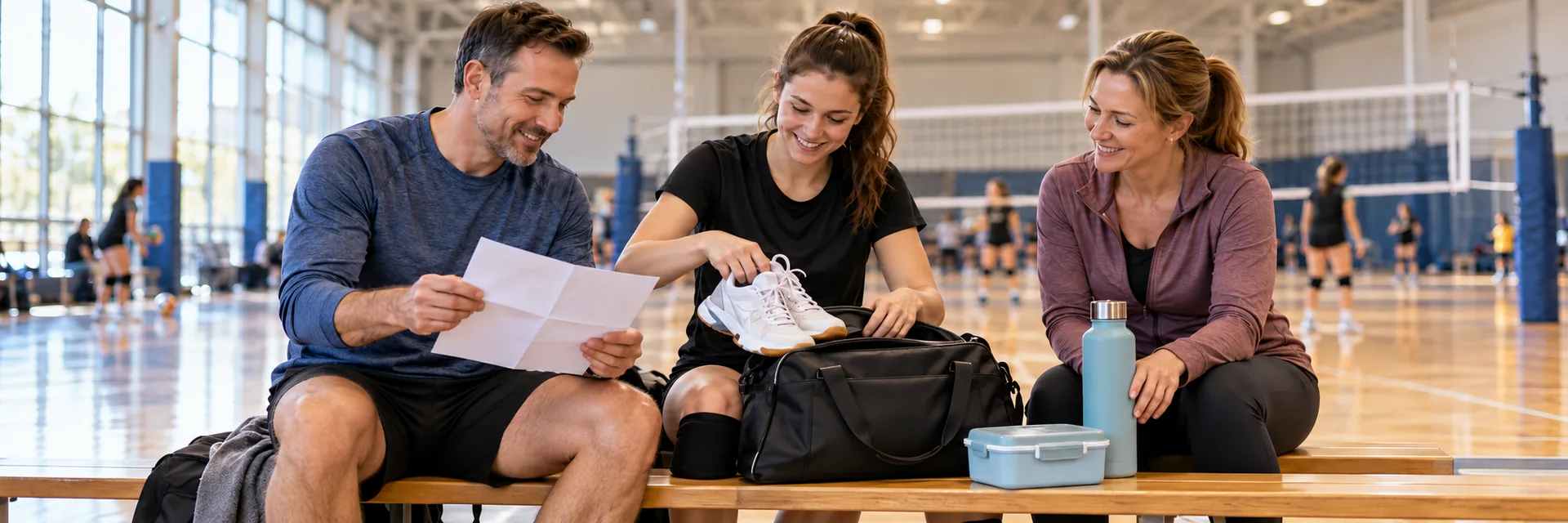
Your child’s first volleyball tournament
Confirm the team’s arrival time, work assignments and departure rules before planning the day. Pack familiar kit, food and water, then leave room for schedule changes and your child’s own experience.
- For
- Families new to indoor tournaments
- Check first
- Organizer and coach instructions
- Example
- Fictional day, not an event schedule
- Download
- Worked plan and blank family checklist
Get six answers before the night before
Ask the team contact for the exact venue entrance, arrival time, first match, warm-up meeting point, any work assignment and the rule for leaving. Arrival time is not necessarily the first whistle. Save the official schedule and contact method so a poor phone signal does not become the day’s main problem.
Ask about parking, admission, seating, food restrictions and whether siblings can attend. Check accessibility and any private support arrangements in advance. Confirm which costs are already covered by the club; this guide does not assume every family needs new equipment or a paid travel package.
- Who sends schedule changes, and where should the player report?
- Does the team referee, score or line judge between matches, and what training is required?
- Who confirms dismissal after the final match or work duty?
Pack for the actual task
Let the player pack with you and check what the club provides. Keep clean court shoes separate from outdoor shoes, and make the uniform, bottle and any personally required items easy to find. A short checklist is more useful than buying a bigger bag.
Use a named bottle, a layer for waiting and a simple way to keep kit together. Follow the venue’s rules for chairs, bags and photography. Keep walkways and run-off areas clear; belongings should never become obstacles beside an active court.
| Group | Check |
|---|---|
| Court kit | Required uniform, clean court shoes and usual personal equipment |
| Waiting | Comfortable layer and a quiet activity if useful |
| Food and drink | Familiar meal/snacks, water bottle and cold storage if needed |
| Logistics | Schedule, route, admission arrangement and team contact |
Make food and drink practical
Plan ordinary familiar food your child is comfortable eating, such as a sandwich or wrap and fruit, with flexibility for a changing break. Check allergies, food-sharing rules and the venue’s policy. A first tournament is not the moment to prescribe an elite diet, count a child’s calories or experiment with supplements.
Pack water and check where refills are available. Provide chances to drink throughout the day, especially with activity or heat; do not turn an adult fluid target into a rule for a child. Follow an individual healthcare plan when one applies.
Food that normally needs refrigeration must stay chilled in a cool bag or box with ice packs until eaten. Wash hands before preparing or eating food where possible. Do not leave a packed meal in a warm car and assume a later break will make it safe.
Between matches, check the next responsibility
Before leaving the court area, confirm the next match, warm-up and any duty with the team contact. A work assignment can follow a loss, so do not infer that elimination means permission to leave. Volunteer only for roles you are trained and authorized to perform; ask for help rather than improvising at the scorer’s table.
Allow a genuine rest break and reconnect at the agreed place. Keep spontaneous ball games away from other courts and busy walkways. If the schedule changes, tell the player what happens next instead of issuing a stream of new instructions.
Support the player and finish the day
Ask what kind of encouragement your child wants. Cheer for the team and let the coach deliver the tactical messages. A later calm conversation is usually better for routine playing-time questions; urgent injury, safeguarding or welfare concerns should be raised immediately through the appropriate local contact.
After the coach confirms dismissal, check kit, rubbish and transport. On the way home, offer food, rest or a quiet conversation rather than an instant performance review. One useful question is: what would make the next tournament easier? Record one change in your checklist, not a verdict about the player’s future.
A first-day plan — fictional and provisional
The team says to arrive at 08:15 for a 09:00 match. It has a 10:00 work duty and an 11:00 match, with afternoon rounds to be confirmed. The family plans a nearby break only after checking the next reporting time. They do not book a fixed departure around the last morning match.
| Time | Plan | Recheck |
|---|---|---|
| Evening before | Pack together; save the route and schedule | Any update from team contact? |
| 08:15 | Meet the team at its stated arrival time | Correct hall, court and warm-up point? |
| After 09:00 match | Drink/rest and prepare for duty | Who is assigned at 10:00? |
| Before 11:00 match | Rejoin the coach’s warm-up | Has the match or court changed? |
| Afternoon | Follow confirmed rounds and duties | Coach confirms dismissal before departure |
Take the worksheet with you
Free A4 and US Letter print-and-write worksheets, with a worked example and a blank template. The UTF-8 text version is editable. No sign-up; these PDFs are not fillable or official competition forms.
A4 PDFUS Letter PDF Editable text
Read the worksheet here
First tournament family checklist
A fictional worked day and a blank practical plan. Organizer instructions govern; no nutritional targets, promised finish time or medical advice.
Worked example — fictional
The team requests 08:15 arrival, a 09:00 match,10:00 work duty and 11:00 match. Afternoon rounds are still provisional. The family saves the venue entrance and schedule, packs familiar food and water, and checks cold storage for the meal.
After the first match, they ask who reports for duty and when the player next joins the coach. They use the remaining time for rest. A long queue changes lunch timing, so they use the familiar packed option rather than miss the team’s reporting time. Departure waits for the coach’s confirmation.
Your blank plan
Date / event / venue entrance: ____________________
Team contact and update method: ____________________
Departure from home / team arrival / first match: ____________________
Parking, admission, accessibility and venue food rules checked: ____________________
Uniform / clean shoes / usual personal kit checked with player: ____________________
Bottle / refill location / familiar food / cold storage: ____________________
Allergy and food-sharing arrangements confirmed privately: ____________________
Warm-up meeting point / next reporting time: ____________________
Work duty / trained responsible person / reporting time: ____________________
First-aid and safeguarding contact route: ____________________
Who confirms dismissal / transport arrangement: ____________________
One observation and one change
What made waiting, food, packing or communication difficult? ____________________
One change for next time, chosen with the player: ____________________
Keep the checklist practical. Team schedules and event rules vary; the worked times above are invented. Do not copy a child’s confidential medical details onto a shared team sheet.
Before leaving, confirm duties are complete, collect kit and follow the agreed dismissal procedure. Rest and the player’s wellbeing matter more than adding another analysis session in the car.
Sources and scope
Checked 30 October 2026. This is an original planning guide, not a tournament regulation or personalized nutrition plan. Organizer rules govern schedules and duties. Public-health sources support ordinary hydration and safe food storage; no adult portions or elite targets are applied to children.
Frequently asked questions
Can we leave when our child’s team loses?
Do not assume so. Confirm any remaining match or work assignment and the coach’s dismissal instructions.
Do we need sports supplements or a special new bag?
This planning checklist does not require either. Start with familiar food and drink, the club’s actual kit list and what your family already has.