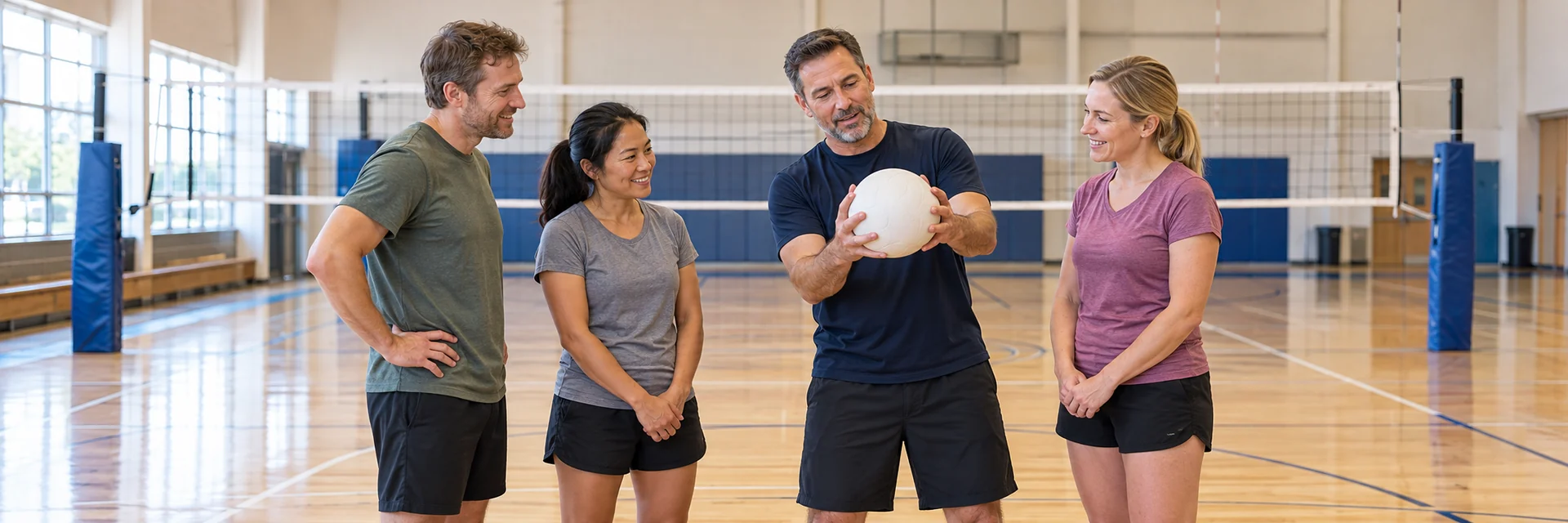
Start Volleyball as an Adult
Your first job is to find a group that welcomes your current level, not to master every skill before joining. Choose a beginner class or suitable recreational session, ask the organizer what to expect, and take one small learning goal into your first practice. Returning players can use the same route without assuming their old workload still suits them.
- Start here
- A beginner-friendly session
- First goal
- Join in and communicate
- Buying gear
- Ask what is needed before buying
- First month
- Repeat and adapt, not a deadline
Find the right kind of group
Look at local clubs, municipal leisure centers, adult-education classes and community sports programs. Your national volleyball federation can be a starting point for finding regional organizations; it is not a guarantee that every local session is listed or beginner-friendly.
| Session | What to check |
|---|---|
| Beginner class | Does a coach teach first contacts, serving and simple games? Is it for adults who have never played? |
| Recreational club | Can you try a session, and are players grouped by experience? Does the group welcome someone joining alone? |
| Open gym / pickup | How are teams chosen, what level is expected, and will anyone explain local rules? “Open” does not necessarily mean beginner. |
| League team | Is there a suitable development squad, a season commitment or a trial? Ask about membership, insurance and the total cost. |
Labels such as social, mixed, B or intermediate mean different things locally. Describe what you can currently do instead of guessing a rating. A friendly organizer who explains the session is more useful than a label on its own.
A message you can send before attending
Hi, I am an adult who is new to volleyball [or returning after a break]. I can currently [describe one skill honestly]. Is this session suitable, and can I come alone for a trial? What should I bring, what is the total cost, and do I need to book or arrange membership/insurance first? Who should I find when I arrive?
Tell the organizer about access or communication needs you want them to accommodate. You do not need to publish personal medical details in a group chat. Ask privately about any participation concern and seek qualified health advice where needed.
Your first session: a small, practical checklist
- Arrive with time to ask. Find the organizer, explain your experience and ask how players rotate into games. Keep bags and bottles away from the playing area.
- Use what you already have if it is suitable. Bring water, comfortable sportswear and clean court-appropriate shoes accepted by the venue. Ask whether a ball is provided and whether knee pads are required; they do not replace learning floor technique. See the equipment checklist before buying.
- Learn three things first. How your group starts a rally, when to rotate, and what call it uses for taking the ball. Rules and team calls are different: read the beginner rules and ask about local adaptations.
- Keep the ball playable. A controlled pass or safe return is more useful than trying a full-power jump serve immediately. Tell your teammates early when you take a ball and leave space for others.
- Choose one next step. Ask the coach for one useful cue. Write it down after the session rather than trying to change every skill at once.
Health note: General information, not medical advice. Young athletes should train under a qualified coach, and anyone with pain or an injury should see a doctor or physical therapist.
Join the warm-up and adapt the session to your current ability. You can ask to observe, reduce repetitions or stop. Pain, an injury or uncertainty about returning after illness deserves qualified advice; this guide is not a medical return-to-play plan.
A flexible first-month example
This is a learning example, not an exercise prescription. Start with a suitable group session, repeat a stage for as long as useful, and account for other sport, work and recovery. The optional short skill practice is optional; it is not an extra jumping workout.
Join in
At the group session: Learn the warm-up, local rules and team calls.
Optional between sessions: Read the rules summary; no extra physical session needed.
What to notice: Can you explain who to ask and how your next session works?
Make a playable pass
At the group session: Ask for one cue that helps control a gentle ball.
Optional between sessions: Try a short partner-passing task if you have space and a partner.
What to notice: Does your partner have time to reach the ball? Keep the same cue if it helps.
Start a rally
At the group session: Practice an appropriate serve with feedback; underhand is a valid starting option.
Optional between sessions: Review serving or repeat an easy task. Rest instead if extra practice would be too much.
What to notice: Is your toss/contact becoming more repeatable? No required success quota.
Play and choose
At the group session: Use the pass, serve and calls in a small game or suitable rotation.
Optional between sessions: Write one thing you enjoyed and one question for the coach.
What to notice: Is this the right group and schedule? Repeat a stage or choose a better-matched session.
If you prefer a more detailed skill sequence, borrow suitable tasks from the seven-session beginner plan. It is seven sessions you may spread out, not a demand to train on seven consecutive days. Solo practice helps parts of a skill but does not replace reading another player’s ball.
Returning after a long break
Tell the organizer both what you used to play and what you can do comfortably now. Start with an appropriate group and ask for fewer demanding repetitions if needed; previous experience is not a reason to copy an old training load immediately. If injury or illness prompted the break, use your clinician’s return guidance rather than a generic calendar.
You do not have to pursue a competitive team. A consistent, welcoming recreational group can be the goal. If you later want league play, ask your club about the next step, relevant competition rules and membership requirements.
Frequently asked questions
Can I start volleyball as an adult with no experience?
Look for a group that explicitly welcomes adult beginners and confirm suitability with the organizer. Start from your current ability; a competitive open gym may not be a teaching session.
Do I need to buy a volleyball and a full kit first?
Ask what the venue and organizer require and whether balls are provided. Suitable existing sportswear and accepted shoes may be enough for a trial. Buy for a real need rather than collecting specialist gear before attending.
Can I join alone?
Many recreational sessions accept individual players, but check booking, team selection and level with the organizer before going. Ask who will welcome you on arrival.
How quickly should I progress?
There is no universal timetable. Choose one useful skill cue, repeat appropriate tasks and ask for feedback. The first-month example is flexible, not a deadline or a medical training plan.