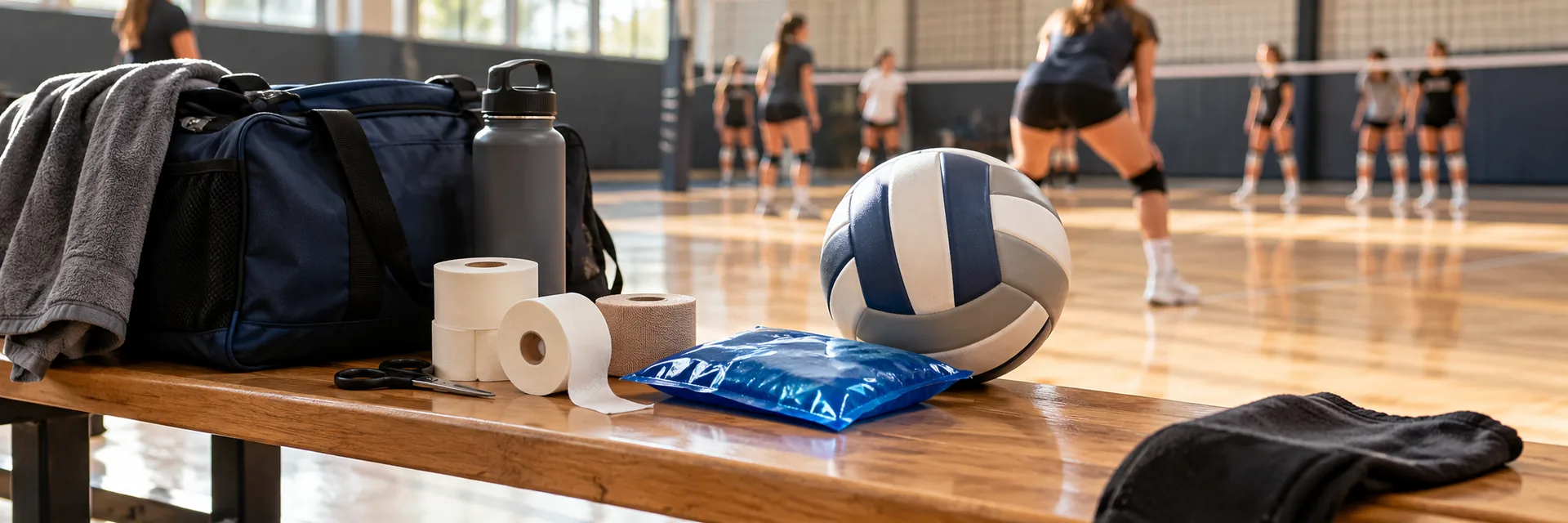
This guide explains what goes in a volleyball kit bag and what each item is for. Most teams need rigid athletic tape, pre-wrap, tape scissors and a way to keep things cold: instant cold packs for away games, and a refillable ice bag or reusable gel pack when there's a freezer or ice nearby. It's a buying guide, not treatment advice: how to tape or use cold on an injury is a question for a doctor, physiotherapist or athletic trainer.
Advertisement disclosure: This guide includes Amazon affiliate links. If you buy through them, we may earn a commission that helps support Learn Volley. As an Amazon Associate I earn from qualifying purchases. We have not personally tested these products; our comparisons use manufacturer information and published sources. Links open Amazon.com; Amazon may offer your local store, and price, stock and sizes can differ by store. How advertising and affiliate links work on Learn Volley.
Our picks with Amazon links are informed by product specifications, Amazon ratings and Amazon’s summaries of customer reviews. How we choose
Health note: General information, not medical advice. Young athletes should train under a qualified coach, and anyone with pain or an injury should see a doctor or physical therapist.
Rigid athletic tape is a non-stretch cotton tape with a sticky adhesive. It holds its shape, which is why trainers use it for strapping ankles and fingers. It isn't the same as stretchy kinesiology tape, which is used differently.
Pre-wrap is a thin, light foam roll that goes on the skin first, under the tape. It isn't sticky and gives no support on its own; it keeps adhesive off the skin and hair and makes the tape easier to remove.
Scissors or a cutter take tape off safely. Bandage scissors have a blunt, angled tip that slides under tape without catching the skin.
Taping a joint is a skill: learn it from a qualified athletic trainer or physiotherapist rather than from a product page.
Ice bag, gel pack or instant pack?
Refillable ice bag: you fill it with ice or ice and water, so it needs a freezer or ice machine nearby. It's reusable and shapes itself around a joint.
Reusable gel pack: you keep it in a freezer between uses. It's ready when you need it at home or at a venue with a freezer, but it warms up during a long away day.
Instant cold pack: single use. Squeeze or strike it to start a reaction that makes it cold. It needs no freezer, which is why it belongs in a first-aid kit for away games, but it doesn't get as cold as ice and can't be reused.
Whatever you use, follow the maker's instructions, including keeping a cloth layer between the pack and the skin where they say so.
Our picks
Tape and pre-wrap
Mueller MTape (2 rolls)
Budget
Best for: team kit bags, for strapping applied by someone trained.
What stands out
Rigid white athletic tape, 3.8 cm × 9.1 m per roll
Cotton backing with a zinc-oxide adhesive; tears by hand
Watch out for: it doesn't stretch and isn't kinesiology tape. Teams that tape every session usually buy bigger multi-roll packs.
Johnson & Johnson Coach porous athletic tape (case of 32)
Budget–Mid-range
Best for: teams and trainers who tape every session.
What stands out
Rigid porous athletic tape for strapping
A case of 32 rolls
Watch out for: a team quantity, sold by a third-party seller; taping should be done by someone trained.
Advertisement · Amazon affiliate link. If you buy through this link, we may earn a commission that helps support Learn Volley.
Best for: teams with a freezer at the gym or at home.
What stands out
Twelve soft gel packs, 15 × 23 cm
Chill them for cold or warm them in a microwave, following Mueller's instructions
Watch out for: they warm up during a long away day, and a box of 12 is a team quantity.
FlexiKold reusable gel cold pack (medium)
Budget
Best for: one player who keeps a cold pack in the freezer at home.
What stands out
A single reusable gel pack that stays flexible when frozen, according to the listing
Double-sealed seams and a nylon cover
Watch out for: the listing makes health claims we don't repeat: it's a cold pack, not a treatment. Follow its instructions and keep a cloth layer between the pack and your skin.
Advertisement · Amazon affiliate link. If you buy through this link, we may earn a commission that helps support Learn Volley.
They need no freezer: squeezing the pack starts the cooling
Watch out for: they can't be reused. We couldn't open Medline's own product page, so these details come from the store listing; read the instructions on the pack.
Who can skip these
An individual player rarely needs their own tape kit: a team or club kit bag, stocked by the coach or team manager, is usually enough. Players who tape the same joint every session should ask a qualified trainer what to use. For the rest of a coach's first-aid list, see Coaching Equipment: first-aid kit, and for injuries see Common Injuries.
How we choose and prices
We compare product specifications and, for products with an Amazon link, their Amazon rating and Amazon’s summary of customer reviews to help you choose equipment. We have not personally tested these products.
Last checked: October 2026. Every pick here is a small purchase (Budget). Multi-roll and multi-pack boxes cost more up front but less per item. Prices vary a lot by country and retailer.
How we choose: we don't test products ourselves. We compare the makers' specifications, such as width, length, material, pack size and how each product is used, with the makers' instructions. No brand pays to be listed, and commissions don't decide which products we pick or their order.
Frequently asked questions
What is the difference between athletic tape and pre-wrap?
Athletic tape is a rigid, sticky cotton tape that holds its shape. Pre-wrap is a thin, non-sticky foam layer that goes on the skin first so the tape doesn't stick to skin and hair. Pre-wrap gives no support on its own.
What kind of cold pack should a volleyball coach carry?
Instant cold packs, because they need no freezer and work anywhere, which suits away games. If the venue has a freezer or ice, a refillable ice bag or reusable gel pack is cheaper over time. Follow the maker's instructions and get medical advice for injuries.