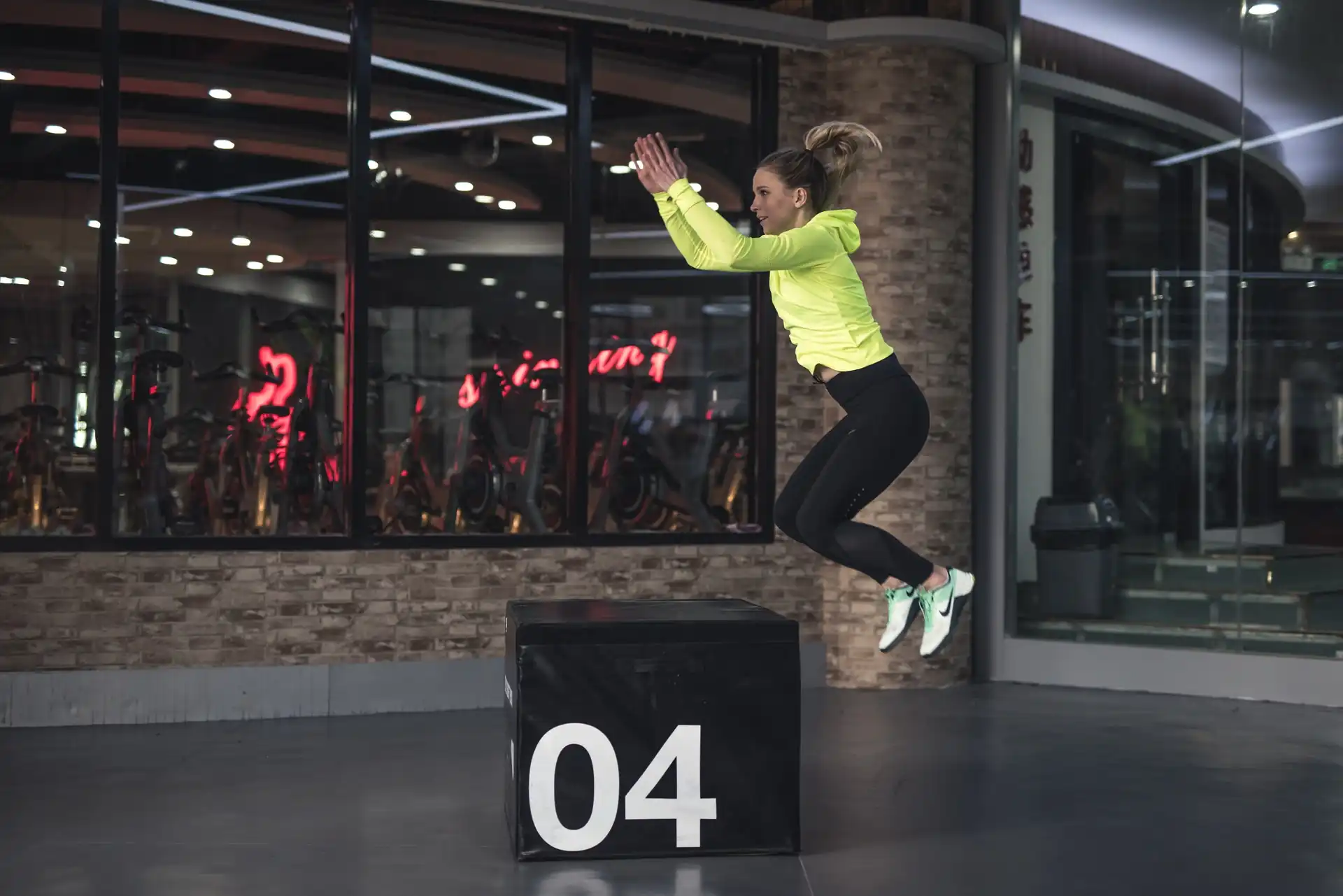
Plyometrics
Plyometrics ("plyos") are fast, springy exercises (jumps, hops, bounds and medicine-ball throws) that teach your muscles to produce force quickly, so you jump higher and move faster. Learn to land safely first, build a strength base, then do about two short sessions a week with 2–3 days between them, and fewer in season, when practice already includes plenty of jumping.
- Frequency
- About 2 per week (less in season)
- Recovery
- 2–3 days between sessions
- Youth reps per set
- Fewer than 6–8 (NSCA)
Health note: General information, not medical advice. Young athletes should train under a qualified coach, and anyone with pain or an injury should see a doctor or physical therapist.
Plyometrics improve jump height, sprint speed, agility and coordination. That helps you jump higher for spikes and blocks and get to the ball faster. They build on the strength you already have, so they work best alongside strength training.
Before you start
Plyometrics put big forces through your knees, ankles and back, so build up to them. You need enough leg and hip strength to control your landings. Always warm up properly first and start with the easiest level.
Learn to land safely
Learn to land before you jump high: land softly on the balls of both feet, bend your hips and knees to absorb the impact, and keep your knees in line with your toes. Don't let them cave inward. Stop the set when your landings get loud or sloppy.
Preparing for indoor training? Compare court-shoe fit and features in our men’s shoe guide and women’s shoe guide. These guides include Amazon affiliate links, labelled as advertisements.
Plyometric exercises by level
Count every landing as one foot contact. Move up a level only when every rep is quiet and controlled.
- Level 1, landing: snap-downs (drop fast into a quarter squat and stick it) and box step-downs to a soft, quiet landing. 2–3 sets of 5.
- Level 2, jump and stick: squat jumps where you land and hold for 2 seconds, and box jumps onto a low box (step down, don't jump down). 3 sets of 5.
- Level 3, jumps in place: jump rope, pogo hops (small, quick bounces on the balls of your feet), line hops forward and back or side to side, and repeated squat jumps. 3 sets of 8–10. Youth athletes: fewer than 6–8 reps per set (NSCA).
- Level 4, volleyball jumps: approach jumps and block jumps at full effort, walking back between reps; lateral bounds. 3 sets of 4–5 with full rest.
- Level 5, single-leg and reactive: single-leg hops forward and side to side over a line, landing on one foot. 2–3 sets of 5 per leg. Depth jumps (step off a box and jump as soon as you land) are only for experienced, strong athletes after months of training, with a coach.
Upper body: medicine-ball chest passes and overhead throws against a wall train fast, explosive arm and trunk movement for hitting and serving.
Jump on a forgiving surface: a gym floor, grass or a rubber mat, not concrete. Quality beats quantity: stop the set when jumps get lower or landings get loud.
A full jump program with strength work and landing practice: how to jump higher.
How much and how often
Do about two sessions a week, with 2–3 days of recovery between them depending on how hard they were, so the same muscles never work hard on back-to-back days. Build up gradually: the NSCA (the US National Strength and Conditioning Association) warns that injury can occur if the intensity, volume or frequency of plyometric training exceeds what the athlete can handle.
During the season
Practices and matches already include many jumps, so in season you will usually need far fewer extra jumps, or none. Skip plyometrics on heavy jumping days. In a study cited by the NSCA, children kept the power they gained from 10 weeks of plyometric training through 8 weeks of reduced training that included soccer practice. To plan lifting, jumps and practice together, see fitting it into your week.
Kids and younger teens
- Kids can do plyometrics when a qualified coach or adult supervises, the volume is low and landing technique comes first. Simple games like hopscotch and jump rope count.
- Keep at least 2–3 days between sessions, and watch for knees caving inward on landings. Fix that before adding more jumps.
- Keep sets short: for power exercises such as plyometrics, the NSCA says fewer than 6–8 repetitions per set are typically recommended for youth.
- Leave depth jumps to older, experienced athletes.
Deep dive: how plyometrics work
When you land or dip before a jump, your muscles and tendons stretch and store energy like a rubber band. If you rebound quickly, you get that energy back as extra height. If you pause, it's lost. Plyometrics train that quick switch from stretching to pushing, and they teach your nervous system to switch muscles on faster and harder. That is why each rep should be fast and full effort, and why tired, sloppy reps do more harm than good.
Watch: vertical jump and plyometric exercises


Videos: Epic Volleyball, Elevate Yourself and Luka Hocevar on YouTube. Learn Volley is not affiliated with these channels.
Frequently asked questions
What is plyometrics?
Plyometrics ("plyos") are fast, springy exercises such as jumps, hops, bounds and medicine-ball throws. They teach your muscles to produce force quickly, which helps you jump higher for spikes and blocks and move faster to the ball.
How many jumps should a beginner do?
Start low and build up gradually. The NSCA warns that injury can occur if the intensity, volume or frequency of plyometric training exceeds what the athlete can handle, and for youth it says fewer than 6–8 repetitions per set are typically recommended for power exercises such as plyometrics. Stop the set when jumps get lower or landings get loud.
Can kids do plyometrics?
Yes, when they are supervised, the volume is low and landing technique comes first. Simple games like hopscotch and jump rope count. Leave depth jumps to older, experienced athletes.