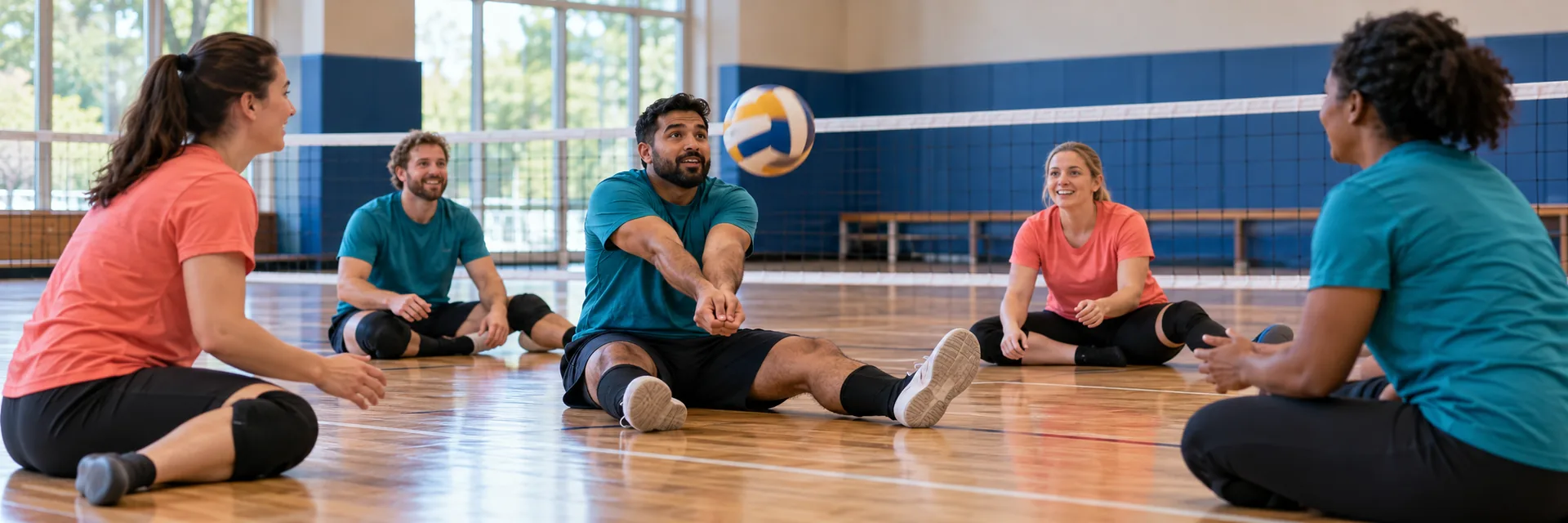
Sitting volleyball: understand the game and try a first session
Sitting volleyball is a distinct form of the sport, played from the floor on a smaller court with a lower net. Start with an accessible, cooperative session and learn its rules separately from standing volleyball.
- Official court
- 10 m × 6 m
- Players
- Six per team in competition
- Rules source
- World ParaVolley 2025–2028
- First-session example
- 30 adaptable minutes, six learners
Who can join a first session?
Ask your local club or federation whether its introductory session welcomes participants with and without disabilities, what support it offers and whether you can observe first. Recreational participation and eligibility for international classified competition are different questions. A diagnosis alone does not establish a player’s sport class; use the organizer’s classification pathway for competitive eligibility.
Plan access before the activity: step-free entry, toilets, space beside the court and any preferred help moving onto or off the floor. Ask the participant privately what works for them. Do not assume someone needs lifting, move their equipment or make them demonstrate a disability to the group. A floor-based activity is not automatically suitable rehabilitation after an injury.
Learn the important differences
The official dimensions below describe World ParaVolley competition. A first lesson may use a smaller space or different net height as an agreed teaching adaptation. Label that change clearly instead of calling it a new official rule.
| Feature | Sitting volleyball | Why it matters |
|---|---|---|
| Court | 10 m × 6 m; each half 5 m × 6 m | Shorter distances change timing |
| Net | 1.15 m for men; 1.05 m for women | Use the applicable competition height |
| Attack line | 2 m from the centre line | Back-row attack restrictions still matter |
| Serve | Blocking the opponent’s serve is permitted | Do not import standing volleyball’s ban |
| Scoring | Sets 1–4 to 25; deciding fifth to 15; win by 2 | Confirm the event’s actual format |
Ground contact is a real rule, with exceptions
During playing actions the basic requirement is contact with the court by part of the body between buttocks and shoulders. Rule 9.4 contains limited defensive lifting exceptions; it is not accurate to say the torso can never leave the floor. Attacking and blocking have their own restrictions. Standing or taking steps to reach the ball is not a legal shortcut.
Receiving-team rotational position is judged from buttocks contacting the floor, not shoes. Serving order still matters even though the serving team can take different positions at the service hit under the current rules. Ask a qualified coach or referee to demonstrate these distinctions before competitive play; a short introduction cannot cover every interpretation.
Start with movement and a reachable ball
Use a smooth, clean, dry surface, secure padded posts and clear space around the activity. Check comfort, clothing and the participant’s own movement choices before adding a ball. Agree a stop signal and pause if pain, skin irritation or fatigue makes participation uncomfortable.
Begin with small, controlled changes of position and a gentle partner toss within reach. Let participants choose a comfortable leg position; do not force a single pose. Keep everyone aware of nearby hands and bodies. Reachable feeds and shorter distances teach control without turning every ball into a chase.
- Try a soft or lighter ball if the first ball is hard to control.
- Use pairs before adding a small cooperative game across a low net.
- Explain any permitted catch before play, then record it as a lesson adaptation.
- Keep rest and observation roles available; participation is not a test of toughness.
Change the task before adding difficulty
If rallies stop immediately, change one thing: feed closer, slow the ball or allow a first-contact catch. If participants are comfortable and communicating, try removing the catch for a short round. Keep the goal understandable and let the group help choose a reachable challenge.
Success in this introduction means finding a comfortable way to participate, knowing the stop signal and coordinating a few contacts. It is not a classification assessment, a fitness test or proof of readiness for a league match. Finish by asking what to keep, what to change and which local session to try next.
A 30-minute introduction — fictional coaching plan
Six new learners use three soft balls, one per pair, and an adjustable net. For the 3 v 3 phase they keep only one ball live and put spare balls clear of movement areas. They agree that the first contact may be caught and gently released. After several rushed attempts they shorten the feed distance, then count cooperative crossings rather than points against one another. These are teaching choices, not World ParaVolley competition rules.
| Time | Activity | Observe |
|---|---|---|
| 0–5 min | Access, court and stop-signal check | Each participant can choose support |
| 5–10 min | Controlled movement without a ball | Comfort and nearby space |
| 10–18 min | Gentle partner toss and pass | Feed is reachable |
| 18–26 min | Cooperative 3 v 3; first-contact catch allowed | Communication and shared contacts |
| 26–30 min | Rest and review | One useful change for next time |
Take the worksheet with you
Free A4 and US Letter print-and-write worksheets, with a worked example and a blank template. The UTF-8 text version is editable. No sign-up; these PDFs are not fillable or official competition forms.
A4 PDFUS Letter PDF Editable text
Read the worksheet here
Sitting volleyball first-session card
An adaptable coaching example and blank plan. Not a medical programme, classification assessment or complete official-rules summary.
Worked example — fictional
Group: six new learners, three soft balls for the partner phase, adjustable low net, 30 minutes including checks and review. Use one live ball for 3 v 3 and store the spares clear of movement areas. Before starting, the leader checks access, dry floor, clear space, post padding and each participant’s preferences. Help with floor transfers is discussed privately and offered only as agreed.
Plan:5 minutes for access and the stop signal;5 for controlled movement;8 for partner toss/pass;8 for cooperative 3 v 3;4 for rest and review. In the game, a first-contact catch is allowed as a stated learning adaptation. Participants may rest or observe whenever needed.
Observe and change one thing
Fictional observation: several balls are too far away and the group rushes. The leader moves the gentle feed closer and repeats the same task. Players then discuss whether the ball was reachable and whether calls were clear; no universal target is needed.
Next choice: keep the catch, remove it for one short round, or return to pairs. Do not increase difficulty simply because a timer ends. Official competition still uses its own ground-contact, attack, serving, rotation and classification rules.
Your blank plan
Date / leader / group size / total time: ____________________
Access and participation preferences discussed privately: ____________________
Surface, clear space, posts, first-aid contact checked: ____________________
Ball / net / available space: ____________________
Stop signal / rest and observation options: ____________________
Movement activity / time: ____________________
Partner activity / time: ____________________
Cooperative game / time: ____________________
Teaching adaptations clearly announced: ____________________
One observation / one change / retest: ____________________
Participant feedback / next local session: ____________________
Before a competition: ask the organizer about training, current rules and the applicable eligibility process.
Sources and scope
Checked 30 October 2026. Rule facts follow the current World ParaVolley linked 2025–2028 English rulebook and approved changes. Session timings and adapted games are original coaching examples, not official rules or clinical advice.
Frequently asked questions
Must I have a disability to try sitting volleyball?
Many introductory or recreational sessions welcome participants with and without disabilities. Ask the provider. International classified competition has separate eligibility requirements.
Is sitting volleyball played in wheelchairs?
Players compete from the floor. A wheelchair may be part of someone’s everyday mobility or access needs, but it is not the playing position shown in the official sitting game.
Can you block a serve?
Yes, blocking an opponent’s serve is permitted in sitting volleyball, subject to the usual restrictions on who may block. Do not transfer the standing indoor rule directly.