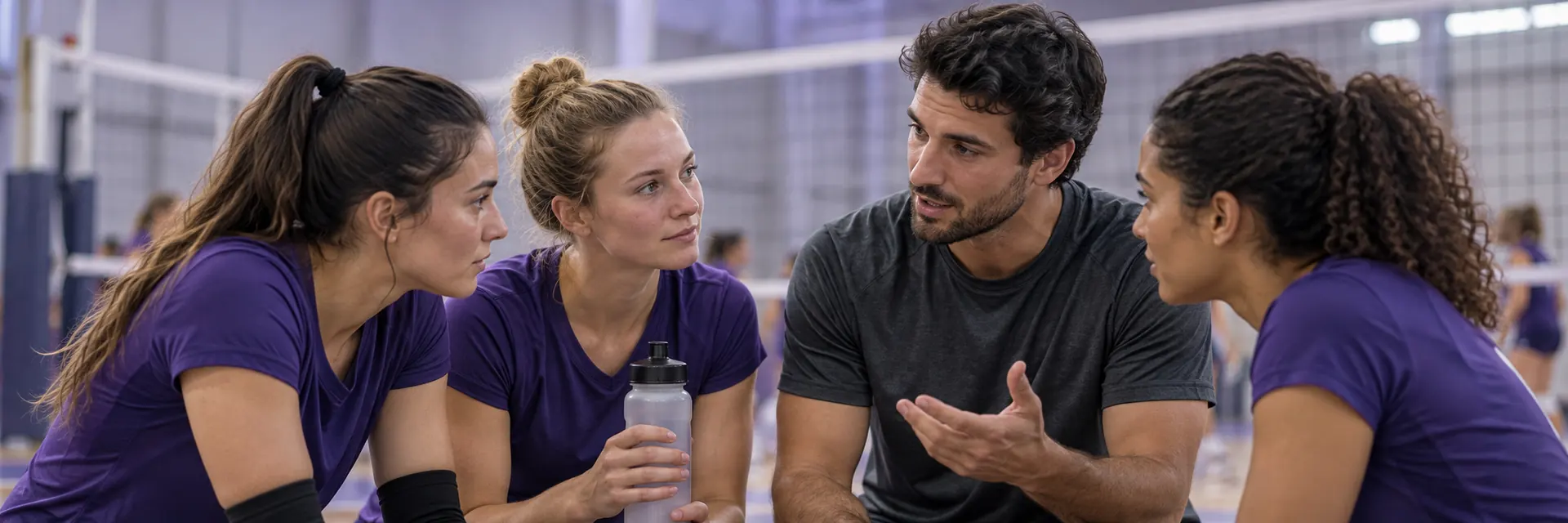
Make Your Volleyball Timeout Useful
Use a timeout to communicate one clear next action, not to list every mistake. Confirm your competition's rules, decide what the team needs, and leave players ready for the next rally.
- Scope
- Indoor volleyball; check local rules
- Coaching aim
- One observation, one action, one check-back
- Download
- Worked example and blank timeout card
Check the rules before choosing a script
Under the FIVB 2025–2028 indoor rules, each team may request up to two timeouts per set. A requested timeout normally lasts 30 seconds; FIVB-approved competition arrangements may change its duration. It is requested while the ball is out of play, before the whistle for service, using the prescribed signal. The coach requests it. In the coach's absence, the game captain may request it unless an assistant has taken over the coach's functions. The game captain must confirm that takeover to the referee. Players in play go to the free zone near their bench.
Those are FIVB indoor provisions, not a universal rule for every league. Youth, school, college and beach competitions can differ. Before the match, confirm who may request a timeout, the signal or buzzer procedure, its length and any event-specific interruptions. Keep a simple record of timeouts used.
Choose a purpose you can describe
A useful reason is something the group can act on: clarify responsibility for a seam, restore a known receiving arrangement, check who takes the second ball, or give players a short opportunity to regroup. A run of lost points can prompt you to look, but it does not diagnose the problem or create an automatic timeout threshold.
Separate observation from interpretation. “Two serves landed between our passers without a call” describes events. “Nobody cares” guesses motives and gives no next action. Ask one player what they saw if you are unsure. You can keep a familiar plan when the team understands it; a timeout does not require a tactical change.
Use a short huddle sequence
Rehearse the sequence in practice so it is familiar before a match. This is a coaching option, not a fixed allocation of seconds. The official's timing always governs; account for walking in and returning to court.
- Gather calmly and check that players can hear. Allow a drink when practical; do not require eye contact from everyone.
- Name one observable situation without blaming a player.
- Give one familiar, realistic action for the next rally. Say who does what, using the team's own calls.
- Ask a player to repeat the action in their own words. Clarify a misunderstanding briefly.
- Finish in time, confirm the next server or receiving responsibility, and return ready to play.
Leave out what the break cannot solve
A short interruption is a poor moment to teach an unfamiliar formation or reconstruct every previous rally. Avoid public blame, threats, punishment exercises and arguments over an official's judgment. Do not promise that a timeout will stop an opponent's momentum or guarantee the next point.
If an athlete is hurt, dizzy or unusually distressed, address safety through the appropriate official and medical procedures. A tactical timeout is not a substitute for assessment or permission to keep an injured player on court.
Practise it, then review the action
In an ordinary practice break, let a player lead a mock huddle about one familiar task. Ask another player what they understood. If teammates repeat different instructions, shorten the message or make the responsibility more specific; speaking louder is not the only answer.
After the match, note the score, the reason, the message and what players tried. Look for execution of the agreed action as well as the rally result. Winning the next rally does not prove the timeout caused it; losing it does not prove that the message was useless. Repeated notes can suggest what to practise next, while opponents, serve quality and small samples still limit conclusions.
Worked example — fictional receiving huddle
At 11–15, a fictional beginner team has let two serves fall between two receivers. The coach sees a late decision, not evidence of poor attitude. The team already has a named seam agreement from practice.
The message is: “We had two balls between us with no early call. Use our seam agreement: the receiver responsible for that seam calls early, and the neighbour clears space. Who owns it in this rotation?” A player repeats the agreed responsibility. The team returns on time.
| What to record | Fictional note |
|---|---|
| Purpose | Clarify an existing seam responsibility |
| Next-rally check | Was the agreed call made early? |
| Result | A playable pass is useful feedback, not proof of a timeout effect |
Take the worksheet with you
Free A4 and US Letter print-and-write worksheets, with a worked example and a blank template. The UTF-8 text version is editable. No sign-up; these PDFs are not fillable or official competition forms.
A4 PDFUS Letter PDF Editable text
Read the worksheet here
Volleyball timeout planning card
A fictional worked case and a blank coaching template; follow your own competition's rules.
Use before the match
Confirm the timeout limit, length, authorized requester and signal with your competition. Identify who records timeouts used. Agree who leads the huddle, where players gather and how the message reaches everyone. This sheet is a coaching aid, not an official scoresheet.
Worked example — fictional
Situation: our beginner team trails 11–15. On two recent serves, the ball fell between two receivers without an early call.
Purpose: clarify the seam responsibility already agreed in practice. We are not installing a new receiving system.
Observation to say: two balls landed between us with no early call. Avoid guessing that players are lazy or afraid.
Next action: the receiver responsible for that seam makes the early call; the neighbour clears space. Ask who owns the seam in this rotation.
Check-back: one player states the existing responsibility. Return before the official's signal to resume.
Review: record whether the next relevant ball had an early call. A won or lost point alone cannot establish whether the timeout helped.
Your blank card
Date / opponent / competition: ____________________
Timeout rule checked / authorized requester: ____________________
Set / score / timeouts already used: ____________________
One observation I actually saw: ____________________
Purpose of this break: ____________________
One familiar next action / who does it: ____________________
Player check-back / what they understood: ____________________
Return-to-court cue / person keeping time: ____________________
Next relevant action observed / context: ____________________
Keep, simplify or practise next: ____________________
Keep the review fair
Discuss actions, not a player's character. Record uncertainty when you could not see the play. Do not use a timeout script to delay safety assessment or pressure an injured athlete to continue. Store notes without unnecessary personal or medical information.
Sources and scope
Sources checked 30 October 2026. FIVB rules 5.1, 5.3, 15.1, 15.3 and 15.4 govern the stated indoor baseline. The huddle, examples and worksheet are original coaching options, not an official programme or a promise of results.
Frequently asked questions
Should I call a timeout after three lost points?
There is no universal coaching threshold. Observe the problem, consider the team's needs and your available timeouts, and choose a purpose players can act on.
Is every volleyball timeout 30 seconds?
No. That is the normal requested-timeout duration in the FIVB indoor baseline, with approved event variations. Check your own competition; do not apply it automatically to school, college or beach volleyball.