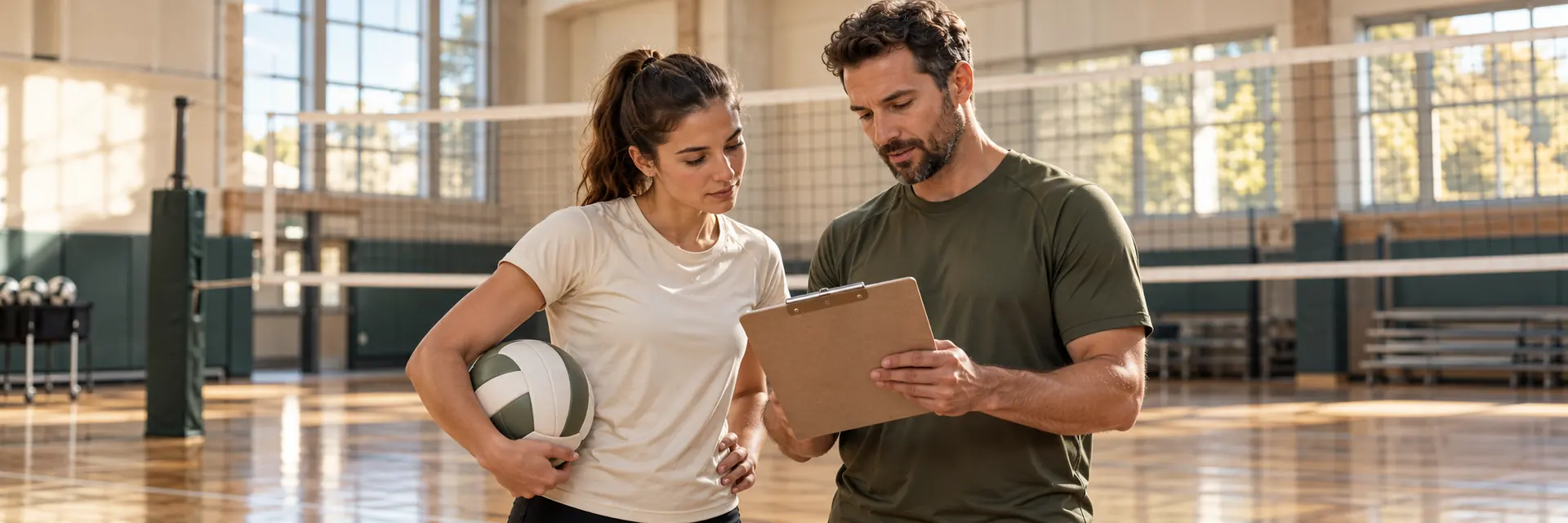
Turn Match Notes into One Useful Practice Task
Choose one question, record what you can actually see, and turn the pattern into a small practice task. Keep the observation definitions and the next check simple; a few match notes suggest a question, not a diagnosis.
- For
- Coaches, assistants and adult learners
- Start with
- One observable question
- Download
- Fictional worked case and blank observation-to-practice sheet
Start with the decision you need to make
Choose a question small enough to observe during play. Can the intended second-contact player reach the first ball without chasing? Do neighbouring receivers call early for balls between them? “Why are we losing?” is too broad for one observer and mixes possible causes.
Agree who watches, which phase and when to stop. An assistant can record a short stretch while the coach remains responsible for players and the match. Parents and players should agree the task with the coach, not create public rankings. Recording must not distract from safety or participation.
Define the labels before you count
Agree categories observers can distinguish: an easy second contact, one after a chase, and no playable second contact. Point out the target and define a chase together. These are local coaching labels, not official statistics.
Keep an unknown category when your view is blocked. Record the number of observed opportunities alongside successes; five early calls means something different out of six chances than out of twenty. If you change a definition halfway through, mark the change and start a fresh group. Do not combine incompatible counts just to create a larger total.
Record context without inventing causes
Record the phase, approximate set or score, identifiable feed or serve type, and observed action. Avoid medical details and unnecessary names. A tally and short note often help more than lengthy commentary. If someone else records, compare how you classified one or two examples.
Separate what happened from your explanation. “No second touch after this serve” is visible. “Bad concentration” is a guess. The opponent may have served more accurately, your line-up may have changed, or one observer may have missed a touch. Small samples are especially sensitive to those differences.
Change one practice constraint
Choose one pattern and one familiar drill. If receivers cannot provide a reachable second contact, begin with a predictable feed and a visible target. If the problem is ownership between players, use two receivers with an agreed responsibility and a safe gap; do not simply demand harder passing repetitions.
After warm-up, eight players can form two groups of four: feeder, passer, target and observer, one active ball per group. Rotate after five feeds so everyone passes and observes. Keep spare balls outside movement areas. Adapt distance and speed, allow rest, and stop for pain or collision risk.
An easier version can use a gentle toss and a catch by the target. A harder version adds a little movement or a live serve only when the current task is manageable. Change one feature at a time so the next observation has a clear purpose.
Choose the next check before the session ends
Repeat the same observation definition in the next suitable practice or match segment. Note conditions that changed. You can ask whether more first balls became reachable or whether an agreed call happened earlier, while accepting that the opponent and task were not identical.
Keep, simplify or progress the task according to what players show and report. Do not treat a tiny improvement as proof that one drill caused it. A fictional worksheet demonstrates a method, not a benchmark all teams should meet. Share the useful action with players and keep individual feedback private and respectful.
Worked example — fictional first-contact notes
An assistant observes 12 serve-receive opportunities in a fictional beginner match. The team has agreed three local labels. Five allow an easy second contact at the intended target, four require a chase, and three produce no playable second contact. One additional rally was obscured and is recorded separately as unknown.
The coach chooses a reachable-target task rather than blaming effort. In two groups of four, players use gentle feeds, a passer and a catching target, with rotating observation. The next check uses the same labels on a new short segment and records any change in feed or opponent. These counts do not establish why the original passes were difficult.
| Fictional observation | Practice decision |
|---|---|
| 5 easy second contacts | Keep a clear target everyone understands |
| 4 after a chase | Try a predictable feed and watch target reachability |
| 3 without a playable second contact | Simplify speed or distance before adding pressure |
| 1 unknown; excluded from the 12 | Preserve uncertainty rather than invent a grade |
Take the worksheet with you
Free A4 and US Letter print-and-write worksheets, with a worked example and a blank template. The UTF-8 text version is editable. No sign-up; these PDFs are not fillable or official competition forms.
A4 PDFUS Letter PDF Editable text
Read the worksheet here
From match notes to practice
Fictional worked example plus a blank adaptable sheet; these are local coaching observations, not official statistics.
Before you record
Choose one question and one phase. Agree the categories with the observer. Define a relevant opportunity and an unknown. Keep player welfare and the coach's match responsibilities first. Collect only information needed for the task; do not publish individual rankings or private medical details.
Worked example — fictional
Question: can the intended second-contact player reach our first contact without chasing?
Local labels agreed before the match: easy second contact at the target; second contact after a chase; no playable second contact. These are not official passing grades.
Observed opportunities: 12. Easy: 5. Chase: 4. No playable second contact: 3. One additional obscured rally stays unknown and is not in the 12.
Practice choice: after warm-up, two groups of four. Feeder, passer, target and observer use one active ball per group. Rotate after five feeds.
Easier: gentle predictable toss, target catches. Add movement or a serve only when manageable. Clear spare balls and rest as needed.
Next check: use the same labels on another short segment. Record different serves, opponents or definitions. Do not infer that the drill caused a change from these small numbers.
Your blank observation-to-practice sheet
Date / observer / team context: ____________________
One question / observed phase: ____________________
Opportunity definition / categories: ____________________
Observed opportunities / counts: ____________________
Unknowns kept separate: ____________________
Context / what changed / what I could not see: ____________________
One familiar drill / reason for choosing it: ____________________
Players / active roles / balls / safe space: ____________________
Easier version / one possible progression: ____________________
Next observation / keep, simplify or progress: ____________________
Before sharing
Describe the action rather than the player's personality. Check that counts add up and unknowns remain visible. Ask players what the task felt like. Share a next action, not a claim of certainty. Retain notes only as long as needed and follow your club's privacy arrangements.
Sources and scope
Sources checked 30 October 2026. USA Volleyball provides coaching and age-appropriate learning resources; Learn Volley's observation categories, fictional counts, drill adaptation and worksheet here are original coaching examples, not a validated assessment or official statistics system.
Frequently asked questions
How many rallies must I record?
There is no universal minimum for this coaching worksheet. Start with a manageable observation task, state the count and uncertainty, and gather more comparable observations before making a strong claim.
Should I use percentages?
Only if the categories and denominator are clear. Keep the actual counts too; a percentage from a tiny or changing sample can look more certain than it is.