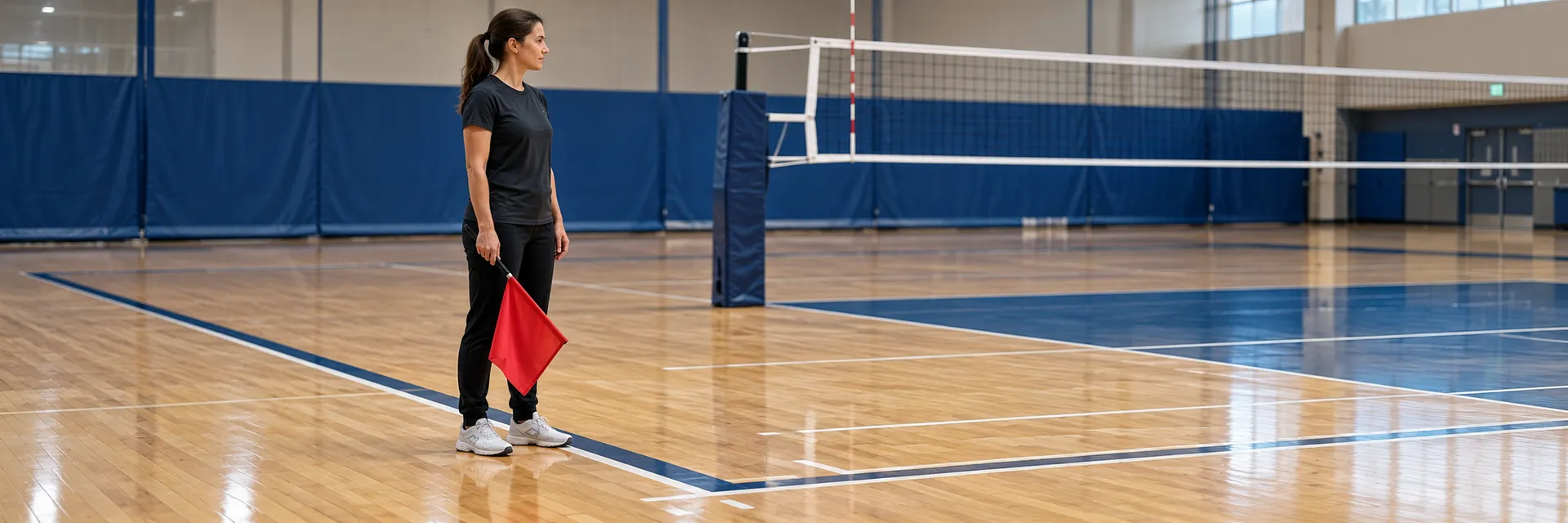
Your first indoor line-judge duty
Check in with the first referee before the match, confirm your corner and assigned lines, and signal only what you actually see. Stay focused on the rally, keep out of the players’ path and make eye contact with the referee after a decision.
Indoor volleyball only. The rules reference here is FIVB 2025–2028, with a separate USA Volleyball note. This is a preparation aid, not an official qualification. Your competition’s training, current rulebook and referee briefing determine your assignment; do not import beach, NCAA or high-school procedures.
Before the first serve
- Tell the referee this is your first assignment. Ask which rulebook applies and who to ask if you need help. Complete any required local training first.
- Ask the referee to show your starting spot, assigned boundary lines and antenna/service-boundary duties. Confirm the signal for a blocked view and how long to hold a signal.
- Get the supplied flag; practise in, out, touched and judgment impossible. Put your phone away and check that your view and escape space are clear.
Where to stand
With two line judges, the FIVB arrangement uses diagonally opposite corners nearest each referee’s right-hand side. Each covers the adjacent end line and sideline. With four, each covers the line assigned to that position. Have the referee point them out; do not choose a corner by following spectators.
Stay outside the court and clear of a server or a chasing player. Adjust safely when needed, then recover your assigned view. Never stand on the boundary, step into a rally to improve the view or block a camera/official.
Your rally routine
- Before the serve: find the server, check the service boundary if assigned, then follow the ball.
- During the rally: watch the ball and any relevant touch; shift your eyes to the landing spot as it comes down near your line.
- At a decision: show a clear signal, look to the first referee and hold it briefly; repeat it if asked. The referee decides the rally outcome.
- If screened: do not guess from the sound, a player’s reaction or the crowd. Use judgment impossible. Do not award a replay yourself.
Five flag signals
| What you saw | FIVB flag action |
|---|---|
| Ball contacts your line or the court | Point the flag down: in. |
| Floor contact entirely outside the boundary | Raise the flag vertically: out. |
| Receiving team clearly touches the ball before it goes out | Raise the flag and touch its top with your free palm: touched. |
| Assigned antenna or service-boundary fault, clearly seen | Wave the flag overhead, then point to the antenna or relevant line. |
| Your view is blocked and you cannot judge | Raise and cross both arms and hands in front of your chest. |
For the server’s foot fault, judge at the service contact or take-off for a jump serve: touching the end line, the court or ground outside the service zone is a fault. Landing inside after a legal take-off is not itself a service foot fault. Check any other assigned service duties in the briefing.
USA Volleyball
USA Volleyball indoor 2025–2027 uses its own rule 27 and diagrams. Its touch duties refer to either team, while FIVB rule 29 uses receiving-team wording. For a ball that rebounds back to the attacking side and lands out, USAV case 27.01 assigns a possible opponent block touch/four-hit decision to the referees: do not improvise a touched call. Confirm the local instruction before play.
Three practice decisions
These rallies are fictional examples under the stated indoor assumptions. Pause before opening each answer; they are not an examination or certification.
1. A small part of the ball touches the paint
The landing is close to your assigned sideline. You clearly see part of the ball contact the line. In or out?
Show the explanation
In. The boundary line belongs to the court. Point the flag down; a ball does not need to land mostly inside.
2. A block touch before an out ball
An attack crosses the net, brushes a receiving-side blocker’s hand, then lands outside that team’s end line. You clearly see the touch and landing. What do you report?
Show the explanation
Touched. Show the touched flag signal rather than reporting a clean out ball. This example is not the different case where a ball rebounds back to the attacking side.
3. A player hides the landing
A player crosses your view exactly as the ball lands. Others shout “out,” but you did not see the contact. What do you signal?
Show the explanation
Judgment impossible. Cross both arms and hands in front of the chest, then look to the referee. Do not guess and do not decide on a replay.
Breaks and finishing
- Between rallies, reset your flag and attention. Do not coach players or debate calls with spectators.
- At time-outs and set intervals, go only to the position the referee specified; remain available and keep clear of warm-ups.
- Do not leave after a set or match until the referee releases you. Return the flag and ask about any uncertainty before your next assignment.
Print the duty checklist
Free A4 or Letter PDF: a short duty guide, fictional decisions and blank assignment record. Follow your event’s actual briefing.
Questions
Do I decide who wins the rally?
No. You provide the information within your assignment; the first referee makes the final decision. Do not add ball-handling or rotation judgments.
What if there are no flags?
Ask the referee for the competition’s approved procedure before play. Do not invent hand signals; USA Volleyball has a specified no-flag alternative, and other rule bodies may differ.
Sources and scope
Checked 28 October 2026: FIVB rules 8.3–8.4, 12.4.3, 29–30 and diagram 12; USAV indoor rule 27, diagram 12 and case 27.01. See the current official sources below.