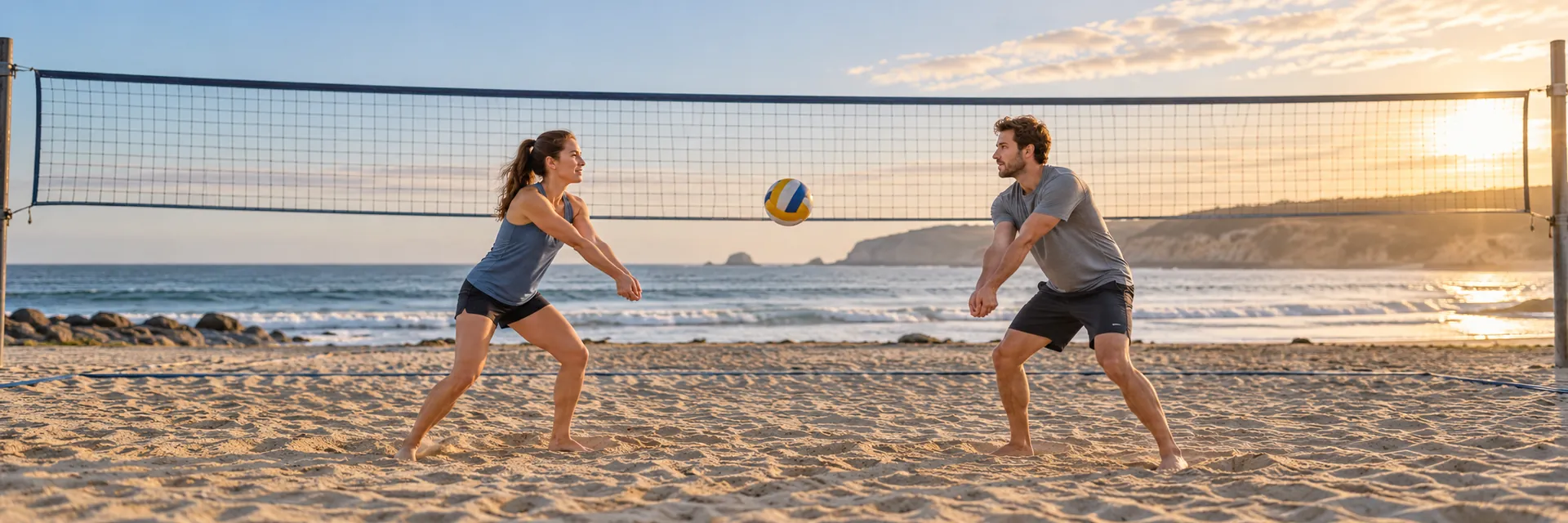
Beach practice for two players, one ball
An adaptable 45-minute beginner session. No third feeder, extra balls or coach required.
Beach Volleyball · Beach rules and indoor differences
Your practice card
Setup and safety
Use one suitable ball, clear sand and flat markers. Start close enough to exchange a gentle toss comfortably. A safely installed net is optional; without one, mark an imaginary dividing line and keep the same cooperative goal.
Check the surface and space around you, remove dangerous objects and keep other users out of the ball lane. Stay on your feet: no diving, hard attacks or jumps are needed. Stop for pain, unsafe weather or loss of control; extend breaks or shorten the session.
0:00–0:08 — Prepare together
Walk and move gently on the sand, make controlled ready-position stops and exchange easy throws. Check that both people can stop and see the ball comfortably. This is a practice warm-up, not the official match warm-up.
0:08–0:18 — Toss, pass, catch
A tosses gently to B. B uses a forearm pass toward A, who catches. Count B’s playable returns from five feeds, then swap roles and record A’s turn. A playable return can be caught without chasing. Easier: move closer or use a lighter suitable ball.
0:18–0:20 — Water and reset
Rest, drink as needed and agree on one cue, such as “move your feet, then aim the platform.” Retrieving the single ball is part of the session; do not rush to meet a repetition target.
0:20–0:30 — Move to a reachable ball
Keep the same roles, but alternate a gentle feed a small step to either side. Initially announce the side. The receiver moves, passes back and resets before the next feed. Swap every five. Observe early movement, not just a lucky catch. Easier: reduce the movement and announce every feed.
0:30–0:40 — Cooperative crossings
Stand on opposite sides of the net or dividing line in a small clear area. Begin with an easy toss; each person tries one controlled forearm return toward the partner. Count consecutive playable crossings, not winners. Reset when control is lost.
Easier: catch and gently re-toss instead of returning immediately. Harder: remove that catch or make the target slightly smaller, one change at a time. With no net this is a partner-control task. This is not a two-against-two match; the catch is a training modification, not a legal rally contact.
0:40–0:45 — Review and collect
Slow down, collect equipment and choose one task to repeat next time. Five-ball counts and the timetable are coaching choices, not age standards or guaranteed improvement.
Date / players: ____________________
Stationary playable returns /5 — A: ____ B: ____
Moving playable returns /5 — A: ____ B: ____
Best cooperative sequence: ____ One useful cue: ____________________
Next practice: repeat / simplify / add one change: ____________________
Take the card onto the sand
Free print-and-write PDF, with the session and blank observation record. No sign-up; not a fillable form.
Use the observation, not a fixed target
Pick one observable change: an earlier first step, a controlled platform, or a return your partner can reach. Compare like-for-like feeds rather than ranking the two players by one short turn.
If moving feeds break down, return to the stationary task. If the ball repeatedly leaves the safe space, shorten the distance or catch and reset. To learn teammate passing and setting with opposition later, join a suitable group; this two-person practice does not replace a full beach game.
Rules and coaching choices
FIVB Official Beach Volleyball Rules 2025–2028, rules 4.1.1 and 9.2.2: official teams have two players; deliberately catching and re-tossing is an exercise modification. The timetable, counting task and target sizes here are our coaching choices, not FIVB standards.
Official FIVB beach rulebook (English PDF)
Rules checked 28 October 2026. No coach endorsement or observed training result is claimed.
Choose the next task
Observe and adjust to wind · Beach Volleyball
Questions about this practice
Can two people practice with only one ball?
Yes. One feeds while the other passes, then you swap; both take part in the cooperative return task. Retrieving the ball is included in the time. There is no hidden third feeder or spare-ball station.
Do we need a net or have to finish in 45 minutes?
A net helps with crossing practice, but a dividing line works for partner control. The timetable is an adaptable example: shorten it, rest longer or repeat one task. Catching is an explicitly modified exercise, not a legal match contact.