
Hitting Lines Drill
Hitting lines are the classic attack drill: players take turns approaching from one zone, hitting a tossed or set ball, then rotating to the back of the line. They give hitters many game-like swings from one position, so they learn timing with a setter and practice hitting to a spot instead of just over the net. They work best with targets on the far side and a clear goal for each round, such as "hit cross-court into zone 5." Keep lines short so players get enough swings without waiting too long.
- Focus
- Approach timing, shot choice
- Level
- Beginner–intermediate
- Players
- 4–12 hitters, plus 1 setter (or a coach who sets), an optional tosser and 1 or 2 ball collectors on the far side
- Equipment
- A net, 1 ball per player in a cart, and 3–4 targets for the far side: cones, hoops, towels or chairs
- Space
- A full court: hitters use one side; targets and ball collectors are on the other
- Time
- 10–20 min
Setup
Over about 8 hitters, run two lines on two courts or from two zones. Change targets every 8–10 swings; switch zones halfway.
- The setter (or a coach who sets) stands at the setter target, between zones 2 and 3 (see court zones), about 1 m off the net.
- Hitters line up outside the sideline next to zone 4 (front left), behind the attack line (10-foot line).
- A tosser with the ball cart stands in zone 6 (back middle) and tosses each ball to the setter. With no tosser, the coach tosses each ball to the setter.
- On the far side, place targets deep in zones 1, 5 and 6 (deep shots are harder to dig). From zone 4, zone 1 is the line shot and zone 5 is cross-court. When the line moves to zone 2, they swap.
- Ball collectors stand outside the far sideline and return balls to the cart between turns. Rotate a new collector in every few minutes.
Hitters (H) line up outside the sideline next to zone 4, behind the attack line. The setter (S) is at the setter target; the tosser (T) is in zone 6 with the ball cart.
H = hitter, S = setter, T = tosser. Blue dots = waiting hitters, grey dots = ball collectors. Green circles = targets.
- The tosser tosses the ball to the setter. Targets sit deep in zones 1, 5 and 6 on the far side.
- The setter sets a high ball to zone 4, about 0.5–1 m off the net.
- The first hitter steps into the court at the attack line, approaches and jumps.
- The hitter hits toward this round’s target, here zone 5 (cross-court). In the target: 3 points.
- The hitter lands on two feet, then walks back to the end of the line along the outside of the court, never under the net. The collectors return the balls.
- Every 8–10 swings, change the target or the zone. Here the line moves to zone 2.
- The setter now sets zone 2.
- From zone 2 the shots swap: zone 5 is the line shot and zone 1 is cross-court. Here: cross-court into the zone 1 target.
How to run it
- The first hitter steps into the court at the attack line in zone 4.
- The ball goes to the setter, who sets a high ball to zone 4, about 0.5–1 m off the net.
- The hitter approaches, jumps and hits toward the target named for this round.
- The hitter lands on two feet and holds a ready stance for a moment.
- The hitter returns to the back of the line along the outside of the court (never under the net while balls are being hit). The ball collectors return the ball to the cart.
- Every 8–10 swings, change the target or the zone (for example, move the line to zone 2).
Scoring
Each swing scores 3 points in the called target, 1 point in bounds, and 0 for a ball in the net or out. Play each round to a team total (for example, 30 points in 12 swings), or have each hitter try to beat their score from the last round.
Safety
Hitting lines involve many jumps in a short time. Warm up fully, limit the number of swings per player, and remove stray balls from the hitting side before each rep. Ball collectors stay outside the sideline. Players on the far side should never stand in a target zone unless they are the active defender in a progression. See warm-up and common injuries.
Health note: General information, not medical advice. Young athletes should train under a qualified coach, and anyone with pain or an injury should see a doctor or physical therapist.
Watch: hitting lines, from basic to block-and-transition
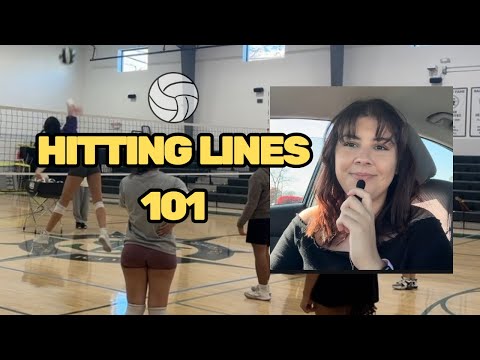
Video: Defying Gravity Volleyball on YouTube. Version 2 adds a block-then-transition start at the net. Learn Volley is not affiliated with this channel.
Coaching this drill
- What success looks like
- The hitter meets the ball high and in front of the hitting shoulder and sends it to the called target, or at least in bounds, then lands on two feet. A hard swing into the net or out scores 0, however powerful it looks.
- One cue
- “Get behind the ball.” Arrive so the ball ends up in front of your hitting shoulder.
- One common error
- Starting too early: the hitter runs under the ball and has to hit it from behind the head, often into the net. Adjustment: cue “wait, then go”; on this high set, wait until the ball nears the top of its arc.
- Make it easier
- Simplify the ball: the coach tosses from zone 3 instead of a set.
- Make it harder
- Add one blocker on the far side in zone 2; hitters practice hitting around or off the block.
- When to progress
- Practice suggestion: when a hitter puts about half of a round of 8–10 swings into the called target, change the target or the zone, or add the blocker. Pick numbers that fit your group: aim before power.
More cues and common mistakes
- “Wait, then go.” When to start depends on the set and on where you start. For a high set to the outside, like the one in this drill, start your approach as the ball nears the top of its arc, not as it leaves the setter's hands. On faster, lower sets, start earlier. If you start farther from the net, begin a little sooner so you still meet the ball in front of your hitting shoulder.
- “Pick the spot early.” Look at the target as you jump, so the swing goes there.
- “Hand on top.” A firm wrist snap over the ball keeps it in the court.
- “Land and ready.” After landing, hold a ready stance for a moment before heading back to the line, as you would in a match.
- Lines too long. Players wait more than a minute between swings. Fix: split into two lines or add a second setter.
- Swinging only at full power. The ball goes long or into the net. Fix: ask for 70% power into the target first.
- Never changing zones. Players only learn one angle. Fix: rotate the line to zone 2 and zone 3.
- Unsafe ball collecting. Players run under the net while others are hitting. Fix: make a rule that balls are collected only along the outside of the court.
More ways to make it easier or harder
- Easier: hitters stand at the net and hit a self-toss over (no jump).
- Harder: start each rep with the hitter passing a free ball from the coach, then approaching (adds transition).
- Harder: add a defender in the target zone who tries to dig the attack.
Frequently asked questions
Should the coach toss or should a setter set?
A coach toss is easier for beginners. A real setter is better once players can time their approach.