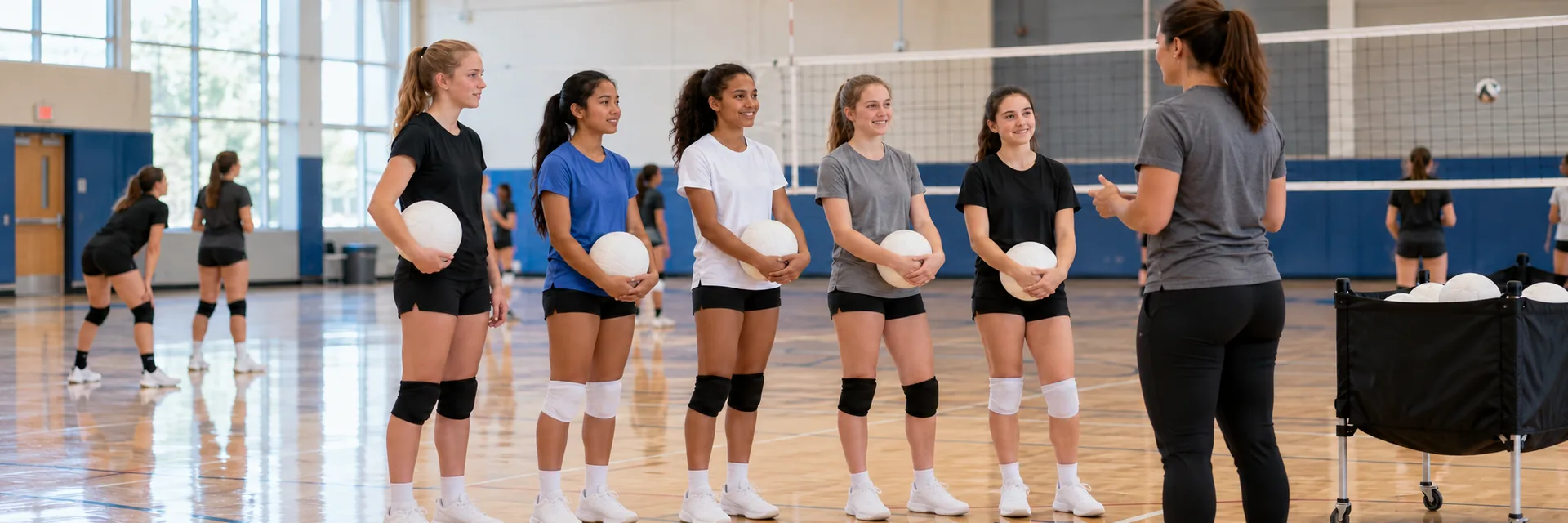
Volleyball Tryouts: How to Prepare Your Child
Volleyball tryouts are one- to three-hour sessions where coaches watch players run drills and play so they can pick a team. Coaches look at ball control, but they also watch effort, attitude, communication and coachability. To prepare: practice the basics in the weeks before, show up rested, and agree on your budget and top choices before the day, because club offers often come with short deadlines.
- Typical length
- 1–3 hours per session
- Skills tested
- Serve, pass, set, attack
- Also judged
- Effort, attitude, communication
- Club offers
- Check the club's or region's rules
- Decide before tryouts
- Budget and top choices
How tryouts work
- School tryouts usually happen right before the season and are run by the school coach. Some schools ask for a medical check or forms before your child can take part.
- Club tryouts or trials are set by each club, sometimes within dates set by the regional federation. Clubs may hold open sessions beforehand so families can look around.
- Registration. Most clubs ask you to register online and some charge a fee. Some require federation registration first. In the US, club tryouts often require a USA Volleyball tryout or full membership, and tryout dates are set by your USA Volleyball region. If your child is trying out for several clubs, budget for each club's tryout fee.
- The session. Players are given a number, warm up, run through skill stations, then play in small games or six-a-side scrimmages while coaches take notes. Some clubs evaluate setters and liberos in a separate group, so tell the club your child's position when you register.
- Offers. Clubs usually make offers by phone or email after tryouts, often with a short deadline to accept (see When an offer comes).
How to prepare
The product links below are Amazon affiliate links: if you buy through them, we may earn a commission. They open Amazon.com, where price and stock can differ by store. As an Amazon Associate I earn from qualifying purchases. How affiliate links work
- Practice the basics. In the weeks before, work on serving, passing to a target and footwork. See Serving, Passing and Setting.
- Build fitness gradually. Add some movement and jumping practice, but don't cram. Always warm up first and learn to land softly on both feet, knees bent — see Warm-Up and Common Injuries.
- Gear check. Court shoes, knee pads, comfortable athletic clothes, a full water bottle and a snack. Hair tied back; no jewelry. Use what your child already has; check the club's kit list before buying anything. If you need them: CamelBak Chute Mag insulated bottle, 32 oz on Amazon.com Nike Brasilia training duffel, Medium (BA5955) on Amazon.com
- Sleep and food. A good night's sleep and a normal meal a few hours before matter more than any last-minute drill.
- Research clubs. Know which teams your child is trying out for and what each costs. See Youth Volleyball Clubs.
What coaches look for
- Ball control. Can your child pass and serve consistently, even if not powerfully?
- Effort and safe decisions. Move early toward playable balls, respect other players and court boundaries, and stop rather than chase into unsafe space.
- Communication. Calling the ball, encouraging teammates.
- Coachability. Listening, trying a correction right away, and asking questions.
- Response to mistakes. Look for a return to the next task with appropriate support; disappointment, quietness or a different communication style is not a character fault.
- Athleticism and potential. Movement, quickness and, at older ages, height and reach — but younger players are often picked for attitude and learning speed.
These are adaptable family suggestions, not universal selection criteria. Confirm your club’s process and safeguards. JVA · USA Volleyball 2025 MAAPP.
On tryout day
- Arrive early so your child can check in and warm up without rushing.
- Agree check-in, supervision and any access or communication support with the club. Encourage appropriate independence without requiring a child to enter alone.
- Use the announced process for routine selection questions and feedback. Raise an urgent injury, safeguarding or access concern immediately; it must not wait until offers.
- Keep the ride home light. Ask “What was fun?” before “How did you do?”
When an offer comes
Accepting an offer usually means committing to the whole season, and it may mean paying a deposit. Before tryouts:
- Read the club's (and, in the US, your region's) offer policy and deadlines.
- Decide your top choices and your budget with your child.
- Get each club's written fee breakdown (see Questions to ask a club).
In the US, check the current region’s age-group tryout, offer and commitment policy before attending, accepting or paying. Ask exactly when an offer becomes binding, what the deadline is and which refund/transfer rules apply; an early offer is not automatically safe to ignore. Other countries and organizations have their own rules. Get the terms in writing rather than relying on a general national date. SCSN 2026–27.
If your child doesn't make the team
Not making a team hurts, and that's OK. Give your child space to be disappointed. Then:
- Ask the coach, politely and later, what your child could work on. Many coaches will share one or two specifics.
- Look at other options: a different team level, another club, a rec league, clinics or private lessons.
- Make a simple skill plan together, like 10 minutes of wall passing a day.
- Remind your child that many good players were cut at least once. Growth and skill can change a lot in a year.
Frequently asked questions
How long do volleyball tryouts last?
Most sessions run one to three hours. Some clubs hold more than one session or a callback day.
Should my child try out for more than one club?
Many families do, so they have options. Check whether each club's offer deadlines overlap.
Do coaches only pick the tallest players?
No. Height helps at the net, but ball control, effort and attitude matter for every position — especially defensive roles like libero.